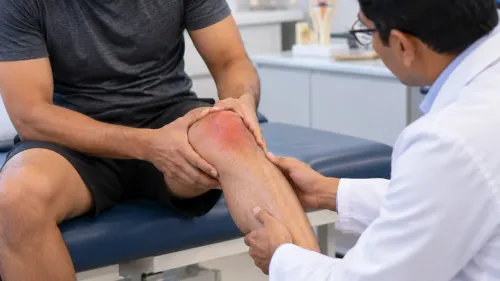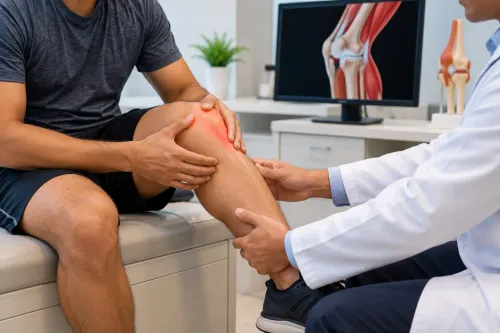
Discomfort after exercise often settles, but pain that persists, changes how you walk or use your arm, limits sleep, or follows a significant injury deserves a closer look. You will be able to distinguish routine soreness from warning signs, understand what an orthopedic assessment involves, and judge when testing or treatment is justified.
Key takeaways
- Seek assessment after two to four weeks without clear improvement.
- Get help sooner if pain disrupts walking, sleep, work or daily tasks.
- Knee, hip and shoulder symptoms can point to different underlying problems.
- Ask what each test will show and which treatment alternatives exist.
How long should joint discomfort last before you seek an assessment?
Arrange an assessment if joint discomfort has not clearly improved after two to four weeks, or sooner if it limits walking, work, exercise, sleep, or daily tasks.
Short-lived soreness after unfamiliar exercise or a minor strain should steadily ease with reduced activity; persistent knee pain, persistent hip pain, or persistent shoulder pain deserves evaluation rather than repeated cycles of rest and flare-up.
Seek urgent medical care when you have:
- Inability to bear weight, fully straighten the knee, or use the arm normally after an injury.
- Sudden severe swelling, a visible deformity, recurrent giving-way, or a joint that became locked after trauma.
- A hot, red, extremely painful joint with fever, chills, or feeling acutely unwell.
- New or progressive weakness, numbness, or loss of sensation.
- Pain that repeatedly wakes you at night, especially with unexplained weight loss or worsening symptoms.
- After joint replacement, new pain with fever, wound drainage, increasing redness, calf swelling, chest pain, or breathlessness.
A first-time shoulder dislocation needs prompt reduction and assessment, not observation at home. For non-urgent symptoms, arrange an appointment when pain persists despite activity adjustment, physiotherapy, or simple self-care, or when hip groin pain, reduced hip rotation, knee locking, or shoulder pain with overhead reaching continues.
The answer to when to see an orthopedic doctor for joint pain is therefore based on duration plus function and warning signs—not on pain alone.
What do knee, hip and shoulder symptoms reveal about the likely problem?
Pain location and the activity that provokes it often point toward different problems, but symptoms alone do not confirm a diagnosis.
| Joint | Symptom pattern | Problems a clinician may consider |
|---|---|---|
| Knee | Knee locking and giving way, swelling after injury, painful stairs, or reduced walking distance | Meniscal or ligament injury, osteoarthritis, patellofemoral pain, or fracture |
| Hip | Groin pain and hip rotation difficulty, pain putting on shoes, or reduced walking distance | Hip arthritis, labral injury, tendon irritation, or referred pain from the back |
| Shoulder | Shoulder pain reaching overhead, weakness lifting the arm, or shoulder pain at night | Rotator-cuff disease, bursitis, arthritis, frozen shoulder, or neck-related nerve pain |
Expect questions about when symptoms began, whether an injury preceded them, which activities worsen them, how long stiffness lasts, and whether swelling appears. The clinician will ask about walking distance, sleep disruption, treatments already tried, and whether pain repeatedly wakes you at night.
The examination may compare range of motion, alignment, joint stability, muscle strength, gait, and crepitus. Localized tenderness helps identify the painful structure, while weakness, altered gait, or inability to fully straighten the knee can raise concern for a more significant injury. A hot, red, severely swollen joint or inability to bear weight needs prompt assessment.
Which tests can explain persistent joint pain?
Imaging helps when the examination suggests a structural problem, symptoms persist despite appropriate care, or a result would change treatment. Blood tests add value when inflammation, infection, gout, or an autoimmune condition is possible; tests may include a full blood count, C-reactive protein, erythrocyte sedimentation rate, urate, rheumatoid factor, or anti-CCP antibodies.
They are not routine proof of osteoarthritis.
| Test | What it can show | When it adds value |
|---|---|---|
| Weight-bearing knee X-ray | Joint-space narrowing, osteophytes, alignment and bone changes under load | Persistent knee pain, stiffness, deformity or suspected osteoarthritis |
| Hip X-ray for pain | Joint-space loss, osteoarthritis, fracture, avascular necrosis or other bone changes | Groin pain, restricted hip rotation, difficulty walking or pain after a fall |
| Shoulder X-ray | Arthritis, fracture, dislocation, bone spurs or calcium deposits | Shoulder pain, reduced movement, injury or suspected impingement |
| Ultrasound for tendon problems | Tendon tears, bursitis, fluid and inflammation during movement | Suspected rotator-cuff, biceps or other superficial tendon problems |
| MRI | Meniscus, cartilage, ligament, tendon, bone-marrow and nerve-related changes | X-rays do not explain significant symptoms, or a specific soft-tissue injury needs clarification |
A scan can look abnormal without causing your pain, while severe symptoms can occur with modest imaging changes. The diagnosis must match the pain pattern, examination findings, strength, movement and functional limits; an X-ray alone does not establish the need for surgery.
When does joint pain need treatment beyond waiting and self-care?
An X-ray showing osteoarthritis does not, by itself, justify joint replacement, arthroscopy, or rotator-cuff surgery. Clinicians match the image with your pain, examination findings, walking or reaching ability, sleep disruption, and response to non-surgical care.
For knee or hip osteoarthritis, therapeutic exercise for osteoarthritis is usually the starting point. A programme combining muscle strengthening and aerobic activity can improve movement; physiotherapy or supervised sessions can help you begin safely and continue consistently.
If you have overweight or obesity, weight loss and joint pain are linked: losing any amount may help, while losing about 10% of body weight often provides more benefit than 5%.
Medication can support exercise when pain blocks activity. Options include topical or oral anti-inflammatory medicines when safe, but kidney disease, stomach ulcers, heart disease, blood thinners, and other medicines affect the choice. An injection may provide temporary relief rather than repair damaged tissue; ask about expected benefit, risks, and corticosteroid injection duration before agreeing.
Clinicians usually consider surgery when substantial pain, stiffness, or loss of function continues despite appropriate treatment and significantly limits quality of life. Use this checklist at the decision point:
- What diagnosis explains my symptoms, not just my scan?
- What exercise, physiotherapy, weight-management, or medication plan should I try first?
- If an injection is proposed, how long should relief last?
- What specific problem would joint replacement, arthroscopy, or rotator-cuff surgery correct?
- What happens if I wait?
What should you ask before agreeing to a procedure or referral?
Use these questions to ask an orthopedic surgeon before you agree to a procedure or referral:
1. What is the working diagnosis, and which symptoms, examination findings, or test results support it? Ask whether the scan shows the pain source or an incidental finding.
2. What improvement should I expect in pain, walking, lifting, sleep, or joint movement, and how will we measure that benefit?
3. What alternatives should I try first? Ask specifically about physiotherapy, strengthening, activity changes, medicines, injections, and observation before considering meniscal tear surgery or rotator cuff tear treatment.
4. Why is a joint replacement assessment appropriate now? Persistent pain or an abnormal X-ray alone does not establish the need for replacement; reduced function and unsuccessful non-surgical care matter.
5. What are the procedure’s specific risks, including infection, nerve or blood-vessel injury, stiffness, blood clots, recurrent instability, or continued pain?
6. What will recovery involve? Ask about hospital stay, wound care, driving, work, exercise, weight-bearing limits, and the time needed to regain useful movement.
7. Who will review me afterward, when is the first follow-up, and which symptoms require urgent contact?
Dr Gaurav Gupta can help assess whether a proposed treatment matches your symptoms, examination findings, and functional limitation rather than an image alone. Take your medication list, previous reports, and a short record of activities you can no longer perform.
Related services
Joint Pain Treatment Joint pain can significantly affect your daily life, limiting mobility and causing discomfort. Dr. View service → |
Knee Arthritis Treatment Knee arthritis is a degenerative condition that leads to joint pain, swelling, and difficulty in movement. Dr. View service → |
Frequently asked questions
How long should joint discomfort last before you seek an assessment?
Arrange an assessment if discomfort has not clearly improved after two to four weeks. Seek help sooner when it limits walking, work, exercise, sleep or daily tasks.
What do knee, hip and shoulder symptoms reveal about the likely problem?
The location, movement pattern, swelling, weakness and pain triggers can help distinguish joint, tendon, ligament, muscle or referred pain. A physical examination is needed to identify the cause.
Which tests can explain persistent joint pain?
A clinician may use a physical examination, X-ray, ultrasound or MRI. The appropriate test depends on your symptoms and what the examination suggests.
When does joint pain need treatment beyond waiting and self-care?
Consider further treatment when pain persists, restricts function, returns repeatedly or has an identified cause that will not improve with self-care alone.
What should you ask before agreeing to a procedure or referral?
Ask what diagnosis the treatment addresses, what benefit to expect, the risks, recovery time, alternatives, cost and what happens if you wait.
Related services
Hip Arthritis Treatment by Dr. Gaurav Gupta focuses on relieving pain, improving joint mobility, and restoring quality of life. View service → |
Shoulder Arthritis Treatment Shoulder arthritis causes pain, stiffness, and reduced mobility, affecting daily activities. Dr. View service → |
Joint Injection Treatment Joint injection treatment is a minimally invasive procedure used to relieve pain, reduce inflammation, and improve mobility in affected joints. Dr. View service → |
Arthritis Treatment Dr. Gaurav Gupta offers advanced and personalized arthritis treatment to help patients reduce pain, improve joint mobility, and enhance quality of... View service → |