A joint can feel less painful while still shifting, buckling, or rotating abnormally because pain relief does not prove that a torn ligament has healed. By understanding which motion the injured ligament controls, you can protect the joint, recognise warning signs, compare treatment paths, and judge recovery by function rather than by pain or a calendar date.
Key takeaways
- Protect the joint, control swelling, and seek assessment during the first 24 to 72 hours.
- Bracing and progressive rehabilitation can restore strength, balance, and controlled movement.
- Consider reconstruction when instability persists despite structured conservative treatment.
- Return to work or sport only after strength, movement, and stability milestones are met.
How do ligaments keep a joint from shifting or rotating?
Ligament structure determines joint stability by limiting movement in specific directions while allowing useful motion. These tough bands connect bone to bone and tighten when a joint approaches a dangerous angle, preventing excessive translation or rotation.
In the knee, the ACL limits forward movement and rotational glide of the shin beneath the thighbone. The PCL controls backward movement, while the MCL resists inward angling of the knee and the LCL resists outward angling.
Ankle ligaments, including the anterior talofibular ligament and calcaneofibular ligament, help prevent the foot from rolling outward. In the shoulder, ligaments help keep the ball centred in its socket during overhead reaches and throwing movements.
A torn ligament causes abnormal translation or rotation, not pain alone. Watch for these practical signs of instability:
- The knee gives way on stairs.
- The joint buckles during a pivot.
- You feel shifting inside the joint.
- You cannot trust the joint during ordinary movement.
- Swelling returns after activity.
Normal walking does not prove rotational stability. Walking on a straight path places less demand on the structures that control twisting, so a joint can seem reliable yet fail during a turn, landing, or change of direction.
What should you do in the first 24 to 72 hours?
For the first 24 to 72 hours, stop pivoting, running, jumping, and impact activity. Protect the joint with a brace, splint, or other support, use compression and elevation, and follow medical advice about weight bearing rather than forcing a painful step.
Seek urgent assessment if you have:
- A visible deformity or dislocated joint
- Inability to bear weight
- A cold, pale, numb, or weak limb
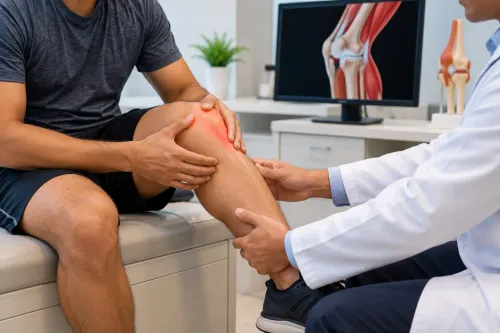
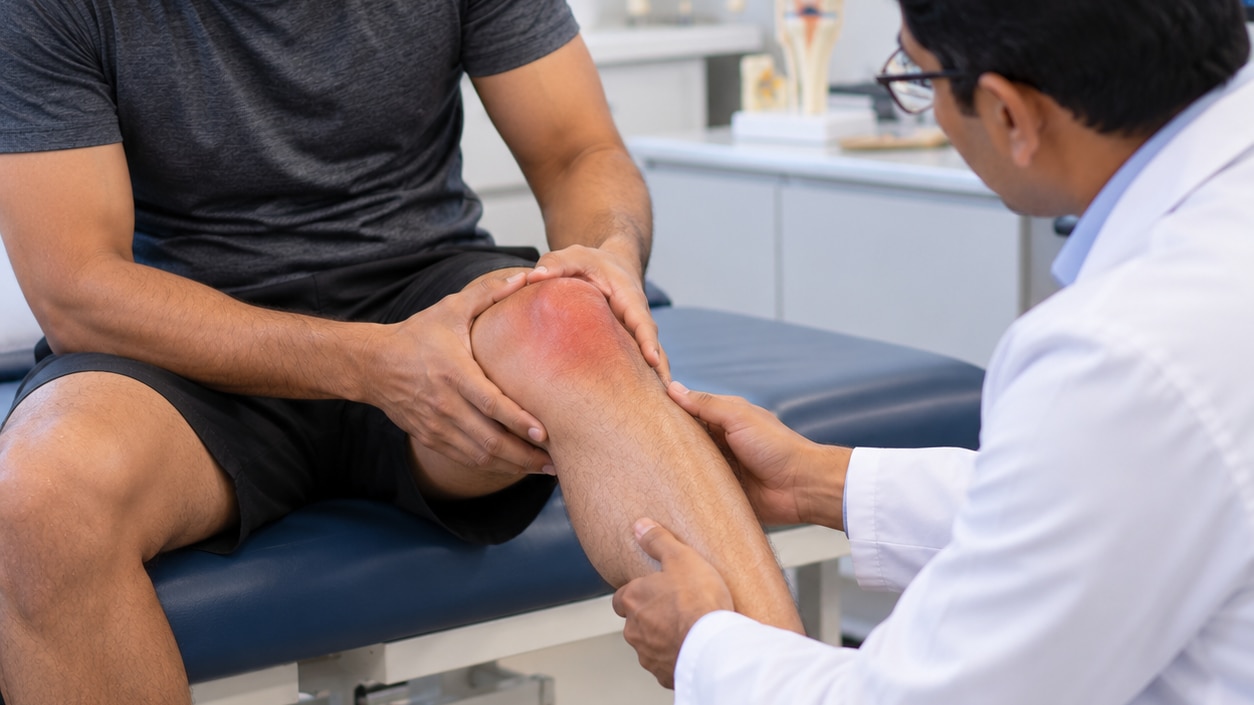
A clinician will ask how the injury happened, inspect swelling and alignment, and assess range of motion. Hands-on laxity tests help identify the injured structure; an MRI should not be interpreted alone.
| Test | What it assesses | What an abnormal result suggests |
|---|---|---|
| Lachman test | Forward movement of the shin | ACL laxity; generally more useful than the anterior drawer test |
| Anterior drawer test | Forward movement of the shin with the knee bent | ACL laxity |
| Posterior drawer test | Backward movement of the shin | PCL laxity |
| Valgus stress test | Inward opening of the knee | MCL injury |
| Varus stress test | Outward opening of the knee | LCL injury |
X-rays look for fracture or dislocation. MRI confirms soft-tissue damage and shows meniscus, cartilage, bone, or additional ligament injuries. In a multiligament knee injury, urgent pulse and nerve checks matter because a reduced dislocation can still have damaged the popliteal artery; abnormal findings or continuing concern may require vascular imaging.
How can bracing and rehabilitation rebuild stability without surgery?
A brace restores stability by limiting the motion that strains a healing ligament, while rehabilitation rebuilds the strength and reflexes that control the joint. Nonoperative treatment therefore targets mechanical support and movement control, not pain relief alone.
1. For an isolated MCL injury, a hinged knee brace limits valgus stress while the ligament heals. Use activity modification and controlled range-of-motion exercises rather than keeping the knee still for weeks.
2. After a common lateral ankle sprain, taping or a functional brace can support early weight bearing as tolerated. Prolonged immobilisation is not the usual goal for a first-time sprain; early motion and strengthening help prevent stiffness and weakness.
3. Progress rehabilitation from swelling control and safe range of motion to quadriceps, hamstring, hip, trunk, and peroneal strengthening. Add balance and proprioception training so your nervous system learns to react before the joint shifts. A brace cannot replace these exercises.
4. Do not label one old sprain as chronic ankle instability. That diagnosis requires repeated giving-way or recurrent sprains plus examination findings. Persistent giving-way after appropriate bracing and therapy warrants reassessment for an associated injury, poor tissue healing, malalignment, or a need for repair or reconstruction.
Pain reduction does not prove that the ligament has healed. Continued instability is the signal to review the diagnosis and treatment plan, not simply tighten the brace.
When is reconstruction more useful than continued conservative care?
Reconstruction becomes more useful when the joint repeatedly gives way despite appropriate rehabilitation, or when your activities demand cutting, pivoting, climbing, or heavy lifting. The decision depends on more than an MRI: assess partial versus complete tear, isolated versus combined injury, ordinary-activity instability, age, skeletal maturity, time since injury, and meniscus or cartilage damage.
| Option | What it means | When it applies |
|---|---|---|
| Rehabilitation | Bracing, controlled motion, strengthening, and balance training without reconstruction | Partial tears, and some complete tears, when lower-demand activities do not cause giving-way |
| Reconstruction | Replacing the damaged ligament with a graft | Recurrent instability, pivoting-sport demands, or associated injuries that need surgical treatment |
| Further assessment | Rechecking laxity, alignment, healing, and associated damage | Persistent symptoms despite therapy or uncertainty about the injury pattern |
ACL reconstruction usually replaces the torn ACL with a graft rather than reattaching the original ligament. An autograft comes from your patellar, hamstring, or quadriceps tendon; an allograft comes from donor tissue.
AAOS recommends an autograft over an allograft for young or highly active patients when reconstruction is indicated, although graft sites have different trade-offs, including kneeling or anterior-knee pain after patellar-tendon harvest.
For an acute isolated ACL tear, AAOS favours reconstruction within three months when surgery is chosen, after swelling and lost motion improve. Dr Gaurav Gupta can weigh examination findings, imaging, activity demands, skeletal maturity, and meniscus or cartilage injury before recommending continued rehabilitation or reconstruction.
Related services
Ligament Injury Treatment Ligament injuries can cause pain, swelling, and joint instability if not treated properly. Dr. View service → |
Multi-Ligamentous Knee Injury Treatment Multi-Ligamentous Knee Injury Treatment A multi-ligamentous knee injury involves damage to two or more ligaments of the knee, often resulting from high-impact trauma or sports injuries. Dr. View service → |
Which milestones show that the joint is ready for work or sport?
Readiness is demonstrated by function, not by a date on the rehabilitation timeline. Early milestones are reduced swelling, full knee extension, and active quadriceps control. Next, regain usable flexion, strength in the quadriceps, hamstrings, hips, and trunk, plus confident single-leg balance without giving-way.
Progress loading in this order:
- Walking without a limp or instability
- Controlled strengthening through the available range
- Linear activity such as cycling or straight-line drills
- Running without swelling afterward
- Deceleration, including stopping from increasing speeds
- Cutting, pivoting, jumping, or contact work
Before demanding sport or physical work, testing can compare strength symmetry between limbs and assess single-leg squats, landing mechanics, a single-leg hop test, and change-of-direction drills. The table shows how these findings affect progression.
| Stage | What to demonstrate | Why it matters |
|---|---|---|
| Walking and strengthening | Full extension, controlled flexion, no swelling increase, and steady balance | Shows basic joint control |
| Running and deceleration | Near-equal strength, quiet landings, and controlled stopping | Tests force absorption |
| Cutting or contact work | Repeated hops, pivots, and direction changes without pain, fear, weakness, or giving-way | Challenges sport or job demands |
Pain improvement alone is not clearance. Reconstruction can correct mechanical laxity while proprioception, strength, confidence, or movement control still lag; reinjury remains possible, especially in young athletes. Obtain sport- or work-specific return-to-sport clearance from examination and test results, not a calendar date alone.
Frequently asked questions
How do ligaments keep a joint from shifting or rotating?
Ligaments connect bone to bone and tighten at specific joint angles, limiting excessive translation and rotation while preserving useful movement.
What should you do in the first 24 to 72 hours after a ligament injury?
Protect the joint, reduce swelling with appropriate rest, ice, compression, and elevation, and arrange a clinical assessment if pain, instability, or loss of function persists.
Can bracing and rehabilitation rebuild joint stability without surgery?
Yes, when the injury and joint remain suitable for conservative care. A brace limits unsafe movement while rehabilitation rebuilds range of motion, strength, balance, and control.
When is ligament reconstruction more useful than continued conservative care?
Reconstruction becomes more useful when instability continues after structured rehabilitation, the joint repeatedly gives way, or the injury prevents required work or sport.
Which milestones show that a joint is ready for work or sport?
You need near-full pain-free motion, minimal swelling, restored strength, good balance, controlled single-leg or task-specific movement, and no giving-way episodes.
Related services
ACL Tear Treatment / ACL Reconstruction ACL Tear Treatment / ACL Reconstruction An anterior cruciate ligament (ACL) tear is a common knee injury, often caused by sports, sudden twists, or trauma. Dr. View service → |
Meniscus Tear Treatment A meniscus tear is a common knee injury that can cause pain, swelling, and limited mobility. At Dr. View service → |
Sports Injury Treatment Dr. Gaurav Gupta offers advanced diagnosis and treatment for sports-related injuries, including ligament tears, muscle strains, fractures, and joint... View service → |